Media Planning Strategy: How a 360 Advertising Agency Builds Campaigns That Actually Convert
At The Media Spaces, a 360 advertising agency built on the belief that every media dollar should be accountable, we've spent years refining a media planning process that blends data, creativity, and channel expertise into one cohesive system. In this guide, we'll break down what media planning strategy really means, why it matters more than ever in 2026, and how a 360-degree approach helps brands cut through the clutter.
Every brand wants its advertising budget to work harder. Yet many campaigns fail not because the creative is weak, but because the media planning strategy behind them was never built to succeed in the first place. Media planning is the invisible architecture of advertising — the decisions about where, when, how often, and to whom your message appears. Get it right, and even a modest budget can outperform a bloated one. Get it wrong, and even brilliant creative gets lost in the noise.
What Is a Media Planning Strategy?
A media planning strategy is a structured, research-backed roadmap that determines how a brand's advertising budget is allocated across channels — television, digital, out-of-home (OOH), print, radio, social media, and emerging platforms — to reach the right audience at the right moment with the right frequency.
It's not simply "buying ads." It's a discipline that answers critical questions before a single rupee or dollar is spent:
- Who is the target audience, and where do they spend their attention?
- Which channels deliver the best return for this specific objective?
- What's the ideal frequency to build recall without causing ad fatigue?
- How do we sequence messaging across the customer journey?
- How will we measure success, and what does "success" even mean for this campaign?
Media planning sits at the intersection of strategy and execution — it's where marketing objectives get translated into a tangible, budgeted, channel-specific plan.
Why Media Planning Strategy Matters More Than Ever
The media landscape has fragmented dramatically. A decade ago, a brand could reach a large share of its audience through a handful of TV networks and newspapers. Today, attention is scattered across streaming platforms, social feeds, search engines, connected TV, podcasts, and countless niche digital touchpoints.
This fragmentation creates both opportunity and risk. The opportunity is precision — brands can now target audiences with surgical accuracy. The risk is waste — without a deliberate strategy, budgets get spread too thin across too many channels, diluting impact everywhere and achieving reach nowhere.
A strong media planning strategy solves this by ensuring every channel selected serves a specific purpose within the broader campaign architecture, rather than being chosen because it's trendy or because a competitor is using it.
The Core Pillars of an Effective Media Planning Strategy
1. Audience Research and Segmentation
Every effective plan begins with a deep understanding of the audience — not just demographics, but behaviours, media consumption habits, purchase triggers, and psychographics. At The Media Spaces, we build audience personas using a combination of first-party data, syndicated research, and platform-level insights to understand not just who the audience is, but where they actually pay attention.
2. Objective Setting (What Does Success Look Like?)
Is the goal brand awareness, lead generation, footfall, app installs, or direct sales? Each objective demands a different channel mix, budget structure, and measurement framework. A campaign optimised for reach looks nothing like one optimised for conversions, and conflating the two is one of the most common — and costly — planning mistakes.
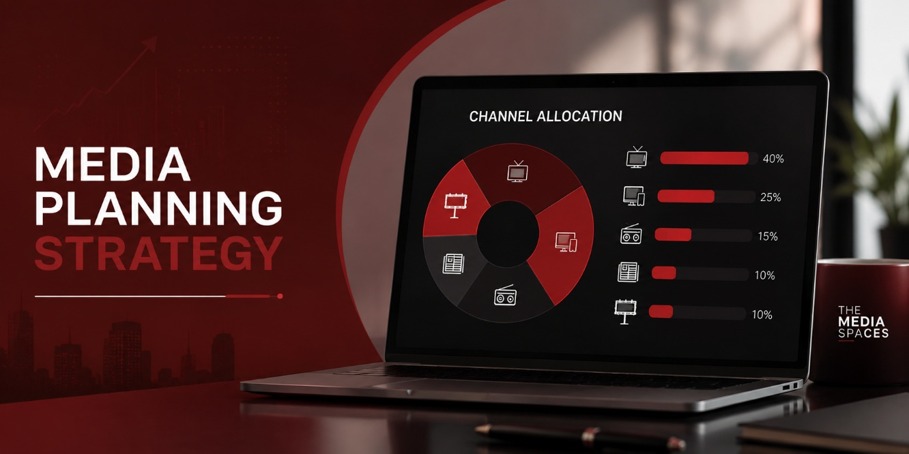
3. Channel Selection and Mix Modelling
This is where a 360 advertising agency advantage becomes clear. Rather than being biased toward one medium (as siloed digital-only or TV-only agencies often are), a 360 approach evaluates every available channel — digital, traditional, OOH, experiential, influencer, and emerging platforms — purely on its ability to deliver the objective efficiently.
4. Budget Allocation and Flighting
Once channels are selected, planners determine how much budget goes where, and when. Should the campaign run continuously, in pulses, or in flights around key seasonal moments? Budget allocation isn't just about splitting a number across channels — it's about sequencing spend to match how the audience moves through awareness, consideration, and decision stages.
5. Frequency and Reach Optimisation
Too little frequency, and the message never registers. Too much, and it triggers fatigue or even brand resentment. Media planners use reach-and-frequency modelling to find the sweet spot — often referred to as "effective frequency" — where recall is maximised without wasting impressions on audiences who've already absorbed the message.
6. Measurement and Optimisation Framework
A modern media plan is never "set and forget." It includes predefined KPIs, tracking mechanisms, and optimisation checkpoints so that underperforming channels can be reallocated toward what's working — mid-flight, not just in a post-campaign report.
What Makes a 360 Advertising Agency Approach Different
Traditional agencies often specialise narrowly — a digital shop optimises for performance marketing metrics, while a traditional media agency leans on television and print relationships. This siloed structure creates a fundamental bias: agencies tend to recommend the channels they're best equipped to sell or manage, not necessarily the ones best suited to the brand's objective.
A 360 advertising agency like The Media Spaces removes that bias by managing the full spectrum of media — from digital and social to television, radio, print, OOH, and experiential — under one strategic roof. This structure offers three distinct advantages:
Channel-Neutral Recommendations: Because we're not incentivised to push one medium over another, our media planning strategy is built purely around what will move the needle for a specific brand and objective.
Unified Messaging Across Touchpoints: A 360 approach ensures consistency in tone, timing, and creative execution across every channel, reinforcing brand recall rather than fragmenting it.
Holistic Budget Efficiency: With visibility across the entire media ecosystem, a 360 agency can identify overlaps, redundancies, and gaps that a single-channel agency can't see.
The Media Planning Process at The Media Spaces
Step 1: Discovery and Brand Immersion
We begin every engagement by deeply understanding the brand — its category, competitive landscape, past campaign performance, and business objectives. This isn't a template exercise; it's a genuine diagnostic phase.
Step 2: Audience and Market Research
Using a mix of proprietary tools and third-party data sources, we map out audience behaviour, media consumption trends, and competitive share-of-voice within the category.
Step 3: Strategic Channel Planning
Our planners build a channel mix grounded in data, factoring in cost-efficiency benchmarks (like CPM, CPC, and CPA across platforms), seasonality, and audience overlap between channels.
Step 4: Media Buying and Negotiation
Strong planning is only half the equation — execution matters just as much. Our media buying team leverages agency-level relationships and scale to negotiate favourable rates and premium placements.
Step 5: Campaign Execution and Real-Time Monitoring
Once live, campaigns are monitored continuously. Our teams track performance daily or weekly (depending on channel), adjusting bids, creative rotation, and budget allocation as real-world data comes in.
Step 6: Reporting, Insights, and Iteration
Post-campaign (and often mid-campaign) reporting goes beyond vanity metrics. We connect media performance back to business outcomes, extracting insights that inform the next planning cycle.
Common Media Planning Mistakes Brands Should Avoid
- Chasing trends over strategy — Jumping onto a platform because it's popular, not because it fits the audience.
- Ignoring frequency capping — Overexposing the same audience while under-reaching new prospects.
- Siloed channel thinking — Treating digital and traditional media as separate strategies rather than one integrated journey.
- Set-and-forget campaigns — Failing to optimise mid-flight based on real performance data.
- Vanity metrics over business outcomes — Prioritising impressions or clicks over actual conversions, footfall, or revenue impact.
How to Measure the Success of a Media Planning Strategy
Success metrics should always trace back to the original campaign objective:
|
Objective |
Key Metrics to Track |
|
Brand Awareness |
Reach, frequency, brand recall lift, share of voice |
|
Lead Generation |
Cost per lead, lead quality score, conversion rate |
|
Sales/Revenue |
ROAS, cost per acquisition, incremental sales lift |
|
App/Store Visits |
Install rate, footfall attribution, cost per visit |
A disciplined media planning strategy defines these benchmarks before launch — not as an afterthought once the campaign is already underway.
Why Partner With The Media Spaces
Choosing a media planning partner isn't just about buying media — it's about partnering with a team that treats your budget as if it were their own. As a 360 advertising agency, The Media Spaces brings together strategic planning, creative execution, media buying, and performance analytics under one roof, eliminating the inefficiencies of managing multiple vendors across fragmented channels.
Our approach is rooted in transparency, data-backed decision-making, and a genuine commitment to measurable outcomes — not just campaign delivery, but business results.
Frequently Asked Questions
Q1. What is the difference between media planning and media buying?
Media planning is the strategic process of deciding which channels, audiences, and timing will best achieve a campaign's objectives. Media buying is the execution phase — negotiating and purchasing the actual ad placements based on that plan.
Q2. How long does it take to build a media planning strategy?
Timelines vary by campaign complexity, but a thorough strategy typically takes two to four weeks, covering research, planning, and internal approvals before execution begins.
Q3. What is a 360 advertising agency, and how is it different from a digital-only agency?
A 360 advertising agency manages the full spectrum of media channels — digital, television, print, OOH, radio, and experiential — under one roof, ensuring channel-neutral recommendations and consistent brand messaging. A digital-only agency is limited to online channels and may miss opportunities across traditional or offline touchpoints.
Q4. How much budget do I need for an effective media plan?
There's no fixed number — effective media planning is about efficiency, not just budget size. A well-structured plan can outperform a larger, poorly allocated budget by focusing spend on the highest-impact channels and moments.
Q5. Can a media plan be adjusted mid-campaign?
Yes, and it should be. The best media plans include ongoing monitoring and optimisation checkpoints, allowing budget and creative to shift toward what's performing best in real time.
Ready to Build a Smarter Media Plan?
If your current advertising approach feels scattered across too many channels with too little to show for it, it might be time for a strategy reset. The Media Spaces brings the research, channel expertise, and buying power of a true 360 advertising agency to every campaign we plan.
Get in touch with The Media Spaces today to start building a media planning strategy designed around your business goals — not around what's trending